Why Slowing Your Breath Changes Your Whole Body
Aug 27, 2026I often call the breath the link — the thing that ties movement, structure, and the nervous system together. Here I want to actually open that up, because it's the part most people have backwards.
Most of us never think about breathing. It's autonomic — it runs on its own, in the background, whether you attend to it or not. That's the trap: whatever pattern you've fallen into runs automatically too. Shallow breathing, high-chest breathing, neck breathing — once those are grooved in, they repeat thousands of times a day, below your awareness, and they don't fix themselves.
But breath is different from every other autonomic system: it's the one you can reach in and change. You can't will your heart rate down. You can change your breath — and because breath is wired into everything, changing it reaches the rest.
In a qigong class I can spot these patterns, and the slow, attended movement helps a better one take hold. But deeply ingrained patterns often need more than a group class to fully re-train — it's why I've developed breath techniques in my clinical work to change that patterning at the subconscious level. The two go hand in hand. For now, here's the foundation: when you change how you breathe, you're not just moving air. You're reaching three things at once.
Before I get to those three things, try this on yourself.
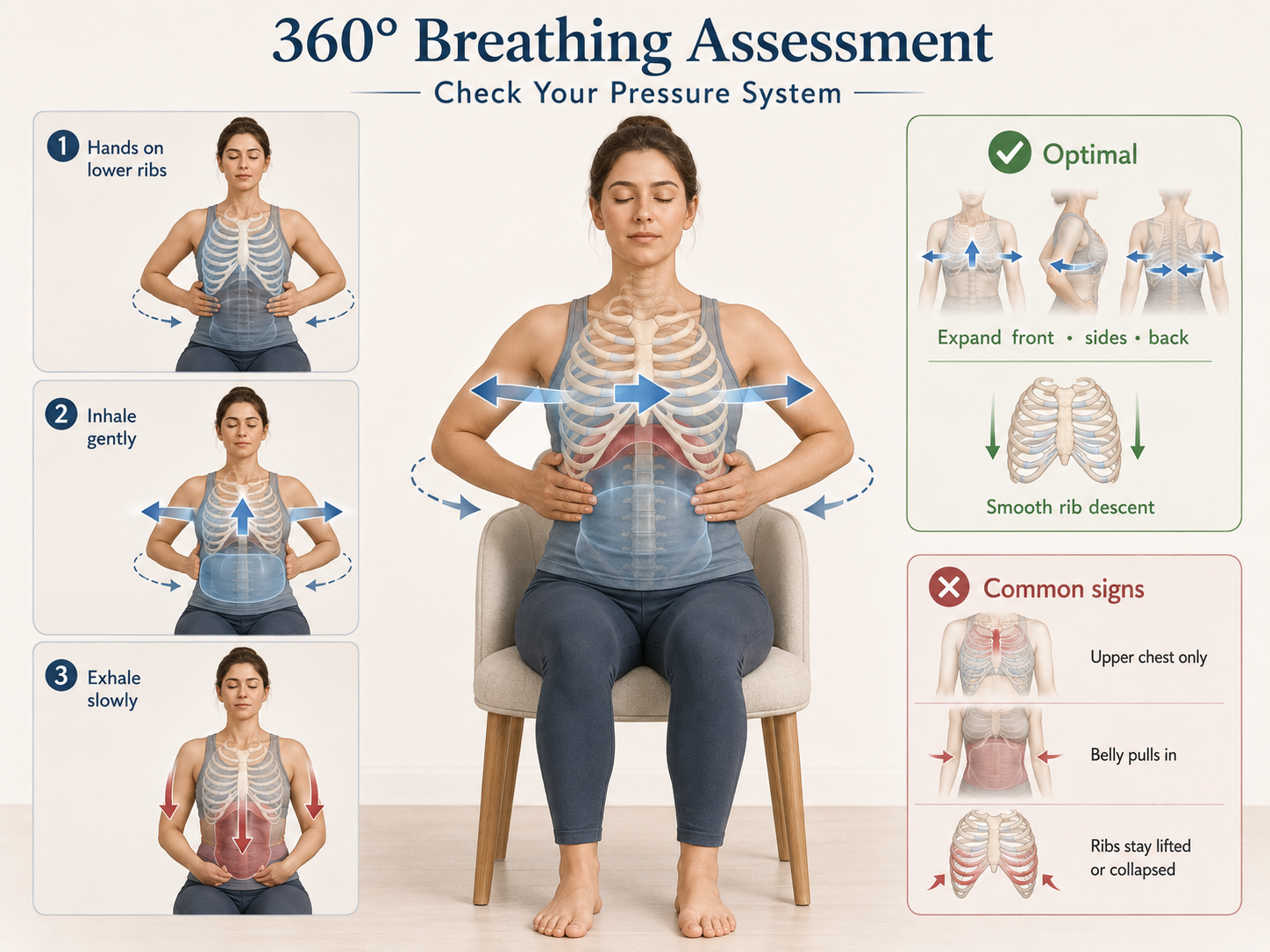
Put your hands on your lower ribs. Breathe in gently and notice where the movement goes. In a good pattern, your ribs expand in all directions — front, sides, and back — and on the exhale they settle down smoothly. The common signs of a stuck pattern: movement only up in the upper chest, the belly pulling in as you inhale, or ribs that stay lifted and never fully descend. There's no grade here — just notice what your body does when you're not managing it. That noticing is the first step, and it's what makes the rest of this make sense in your own body.
The first is your nervous system. A long, slow exhale is a direct signal to the body that it's safe to downshift — it shifts you out of the braced, sympathetic "ready" state and into the rest-and-recover side. This isn't relaxation as a mood. It's a physiological gear change, and the breath is the gearshift. Speed the breath up and shorten it, you climb toward alertness and stress. Slow it and lengthen the exhale, you come down. You have a hand on that lever any moment you choose to use it.
The second is structure — and this is the part I've spent years on. Every breath changes the pressure inside your torso. The diaphragm drops, the abdominal wall responds, and that pressure — the intra-abdominal pressure, the hydrostatic pressure of a body that's mostly water — is part of what holds you up. It's load-bearing. Breathe in a shallow, braced, high-chest way and you rob your structure of that support. Breathe in a way that manages the pressure well and you give your spine and your whole trunk a source of stability that no muscle can provide on its own. I found this so central to how the body organizes that I ended up writing a whole book about it — pressure as the organizing principle of human structure. It's finished now, and I'm currently in talks with publishers.
The third is the link between the other two. Because the same slow breath that calms the nervous system is the one that manages the pressure well. You don't get to pick between a calmer mind and a more supported spine — the breath that gives you one gives you the other. That's not a coincidence. That's the design.
This is why breath sits at the center of qigong. The movements aren't performed and then you breathe. The breath drives the movement — it sets the pace, regulates the pressure, and keeps the nervous system in the settled, attentive state where the tissue actually adapts. Take the breath out and you're just doing shapes. Put it back in and the shapes become the practice.
Here's what strikes me most. The traditions that built these practices didn't have the words intra-abdominal pressure or vagal tone. They couldn't measure any of it. But they organized entire systems of movement and health around the breath anyway — because thousands of years of careful attention told them it was central. They were right. They just described it in a different language.
— Isaac