Two Languages for the Same Body
Sep 17, 2026There are two languages for what the breath does: the measurable one and the traditional one. I want to spend this post on why I keep both — because it's the heart of how I teach, and it's not a compromise. It's the actual point.
Here's the situation qigong puts you in. On one side you have the traditional framework: qi, meridians, the five elements, energy moving through channels. Thousands of years old, poetic, and — to a lot of people raised on Western science — a little hard to swallow. On the other side you have anatomy and physiology: fascia, intra-abdominal pressure, vagal tone, the mechanics of a joint moving through its range. Measurable, testable, familiar.
Most people feel they have to choose. Either you buy the mystical language and switch off your skepticism, or you keep your skepticism and dismiss the whole tradition as pre-scientific superstition. I've watched people do both, and I think both are a mistake.
Here's what nearly thirty years of working on bodies taught me. When a tradition organizes an entire system of health around something, and that system keeps working for thousands of years across millions of people, the tradition is usually pointing at something real — even if the words it uses aren't the words I'd use. The old practitioners couldn't dissect fascia or measure a nervous system. What they had was attention. Generations of careful, patient observation of what the body does and what helps it. They built a language to hold what they found. That language is qi and meridians and elements.
When I feel qi described the traditional way and then look at what's measurable — the shift in the nervous system, the change in fascial tone, the pressure moving through the trunk — I don't see two competing claims. I see the same phenomenon described from two directions. The tradition names what it feels like from the inside. The science names what's happening in the tissue. Neither one cancels the other. You lose something real if you throw either away.
So I don't. When I teach, I'll tell you the meridian a movement is said to open, and I'll tell you what's happening in your fascia and your breath and your nervous system while you do it. Not one instead of the other. Both, side by side, because both are true and each one deepens the other.
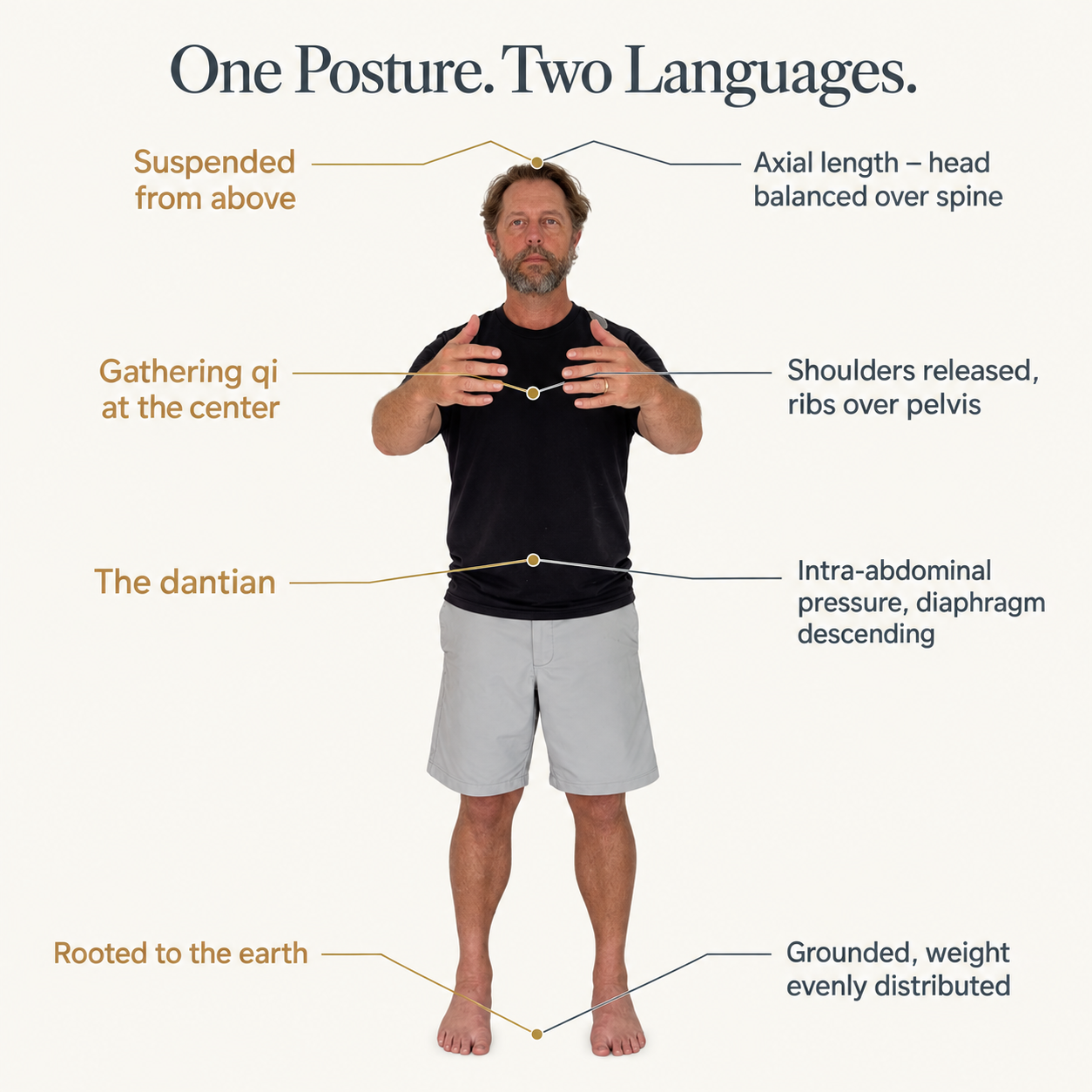
That's the difference I want to offer. Anyone can follow a qigong video — copy the shapes, move along. What I can do is help you notice what you're already feeling as you move, and connect it to what's happening underneath — your fascia, your breath, your nervous system — alongside the traditional framework that's guided this practice for centuries. Whatever you feel is yours. My job isn't to tell you what it should be; it's to help you pay closer attention to it, and to give you a way to understand it. You don't have to take anything on faith, and you don't have to dismiss anything either.
That's the practice I've built. If you're in Santa Barbara, you can come do it with me: see the current qigong series.
— Isaac