Rolf Called It the Line
Aug 20, 2026Qigong turned out to be the missing piece in nearly 30 years of clinical work. Here I want to show exactly where it fits — and to do that I have to start with a word Ida Rolf used constantly: the Line.
In Rolfing® Structural Integration, the Line is the reference point. It's the vertical axis the whole structure organizes around, and we understand every joint by how it relates to it. You don't treat a shoulder as a shoulder; you ask how that shoulder is sitting relative to the Line, and what it's doing to everything above and below it. The Line is how you make sense of the body as one connected system instead of a pile of parts.
Here's what I learned working with it over the years.
Rolfing changes the form. My hands work the fascia and connective tissue directly, and when the form reorganizes, function follows — you move differently because the structure underneath you is different. Corrective exercise comes at it from the other direction: it changes the function — how you actually move and load — and changed function reshapes the form over time. One works form-to-function, the other function-to-form. Put them together and you can change a body from both ends. In clinical work, that integration was powerful.
Then I went deep into the breath. Breath mechanics turned out to be a third door: the breath regulates the nervous system and changes structure at the same time. That was often the difference between someone getting out of pain and staying there — and between decent movement and real athletic performance.
Three good tools. But they were three separate acts. Hands-on work, then corrective drills, then breath work. Each one powerful on its own, and I could sequence them intelligently — but the flow between them was missing. There was no single practice where form, function, breath, and nervous system moved together as one continuous thing.
That's what qigong does.
The spiral movements work the fascia — not the way Rolfing does, but in their own way. Fascia doesn't release, the way people often say; it adapts — to load, to hydration, to the input of the nervous system, over time. That's what the movement gives it: repeated, deliberate load that helps the tissue adapt, opens what's gotten stuck, and helps the fascial layers glide and organize better. It's a different mechanism than Rolfing, and a self-directed one — you're doing it under your own power, over and over, so the work keeps adapting between sessions instead of slipping back.
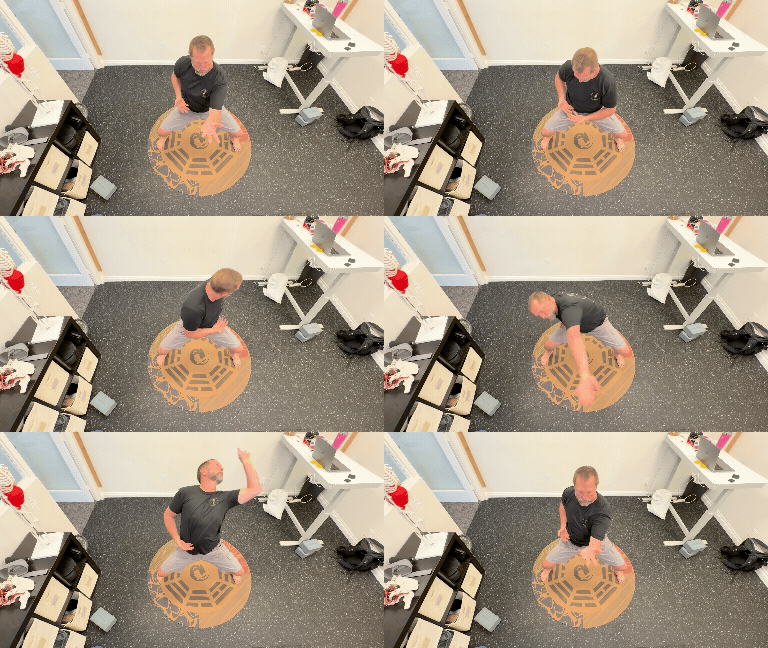
The same movements, repeated with attention, reprogram the nervous system — they change function, the way corrective exercise does. And the breath is the link between the two, because the breath is the one thing that regulates the nervous system and changes the structure in the same instant. Qigong runs all three doors at once, in continuous motion — and it organizes that motion around a central axis. Around the Line.
That's the integration I'd been building toward for nearly three decades without a container to hold it. Not a replacement for the clinical work — the living continuation of it.
— Isaac
Rolfing® and Rolfer® are registered service marks of the Dr. Ida Rolf Institute®. Isaac Osborne is a Certified Advanced Rolfer®.