
Your Fascia Doesn't Release. It Adapts.
Oct 01, 2026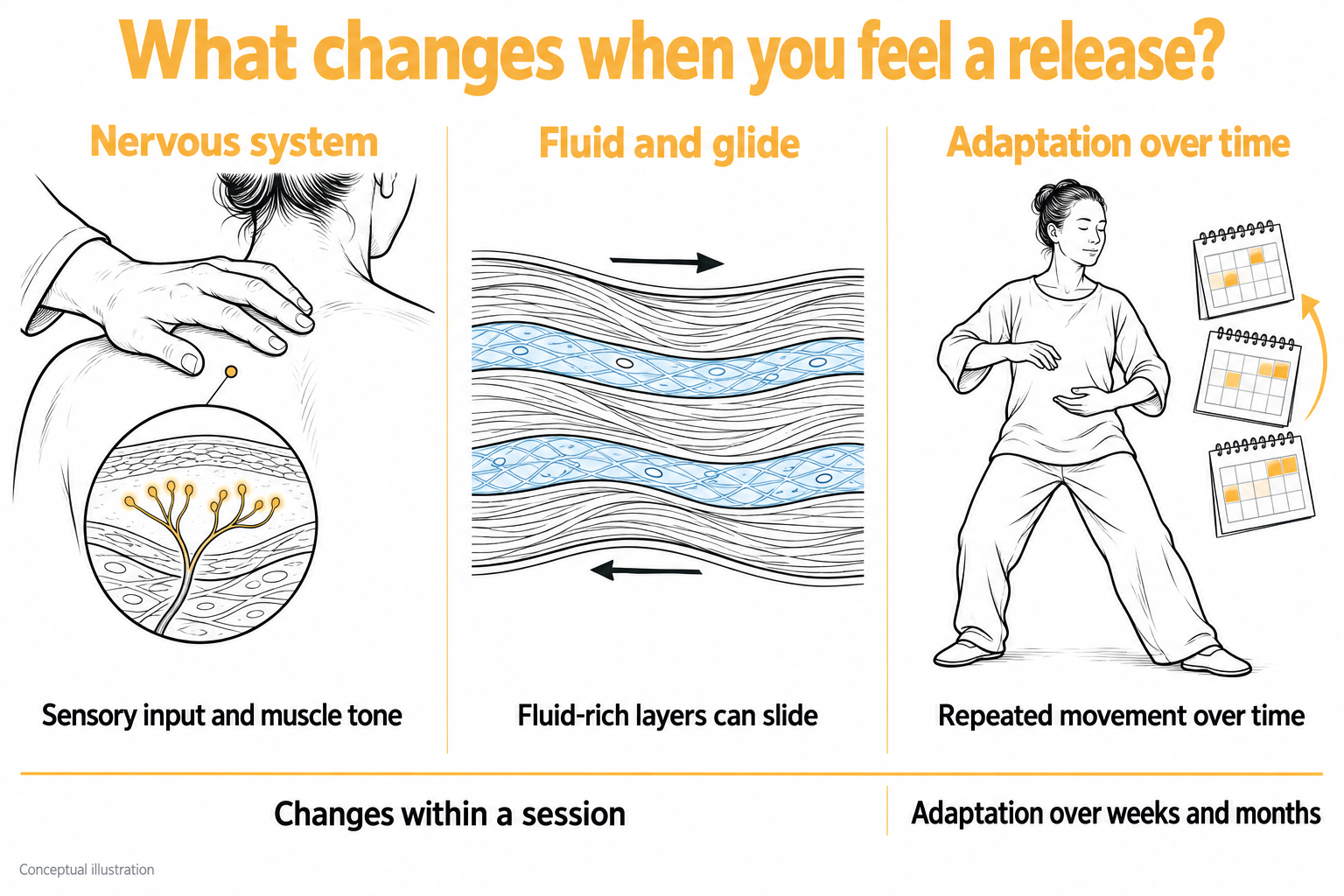
If you've had bodywork of almost any kind, you've heard some version of it: we're going to "release" your fascia. It's the default phrase in the field. As it's usually meant, an immediate, lasting reshaping of dense connective tissue under the hands, it doesn't hold up well. The difference matters for how you think about changing your body.
What fascia is
Fascia is the connective tissue that wraps and links everything in the body: muscles, organs, bones, nerves. Some of it is thin and loose. Some of it is dense and built to carry load: the iliotibial band on the outside of the thigh, the plantar fascia under the foot, the thoracolumbar fascia across the low back.
Dense fascia is made largely of collagen, arranged to resist tension. It is tough by design. That's its job.
Why "release" doesn't hold up
"Release" suggests something gives way under the hands: tissue that melts, lets go, or is lengthened in a single session.
A 2008 mathematical model estimated that producing even 1 percent compression or shear in the fascia lata (the tissue that includes the IT band) or the plantar fascia would require forces beyond the normal physiological range, under the model's assumptions. The authors therefore questioned whether the release felt during manual therapy could come from that kind of deformation in these dense tissues. That challenges the usual explanation of release. It doesn't mean dense fascia can't deform or adapt.
The research on foam rolling raises the same question. A 2019 review in Sports Medicine found insufficient evidence that rollers work by releasing fascial restrictions, and called the term "self-myofascial release" misleading. Possible contributors to what people notice include nervous-system responses, changes in blood flow, and changes in tissue hydration and stiffness.
And yet people do move differently after good hands-on work or a movement session. Something changed. The most likely candidates are below, and they aren't mutually exclusive.
What may actually change
1. The nervous system responds
Fascia is richly supplied with sensory nerve endings that respond to pressure, stretch and movement. A 2022 systematic review found them throughout the deep fasciae, and the thoracolumbar fascia across the low back is richly supplied with sensory nerve endings. The nervous system sets muscle tone and decides how much movement feels safe, and it takes in a great deal of information from these tissues.
So one plausible response to slow, clear input is reduced guarding and a change in pain sensitivity. That doesn't rule out local changes in the tissue. It means the nervous system is very likely part of the picture.
A 2025 review of 62 reviews on the mechanisms of manual therapy found that some nervous-system responses were supported by reviews of moderate methodological quality, while reviews reporting biomechanical responses were rated critically low. The authors also emphasized that it remains uncertain which measured responses explain clinical improvement.
2. Hydration and glide
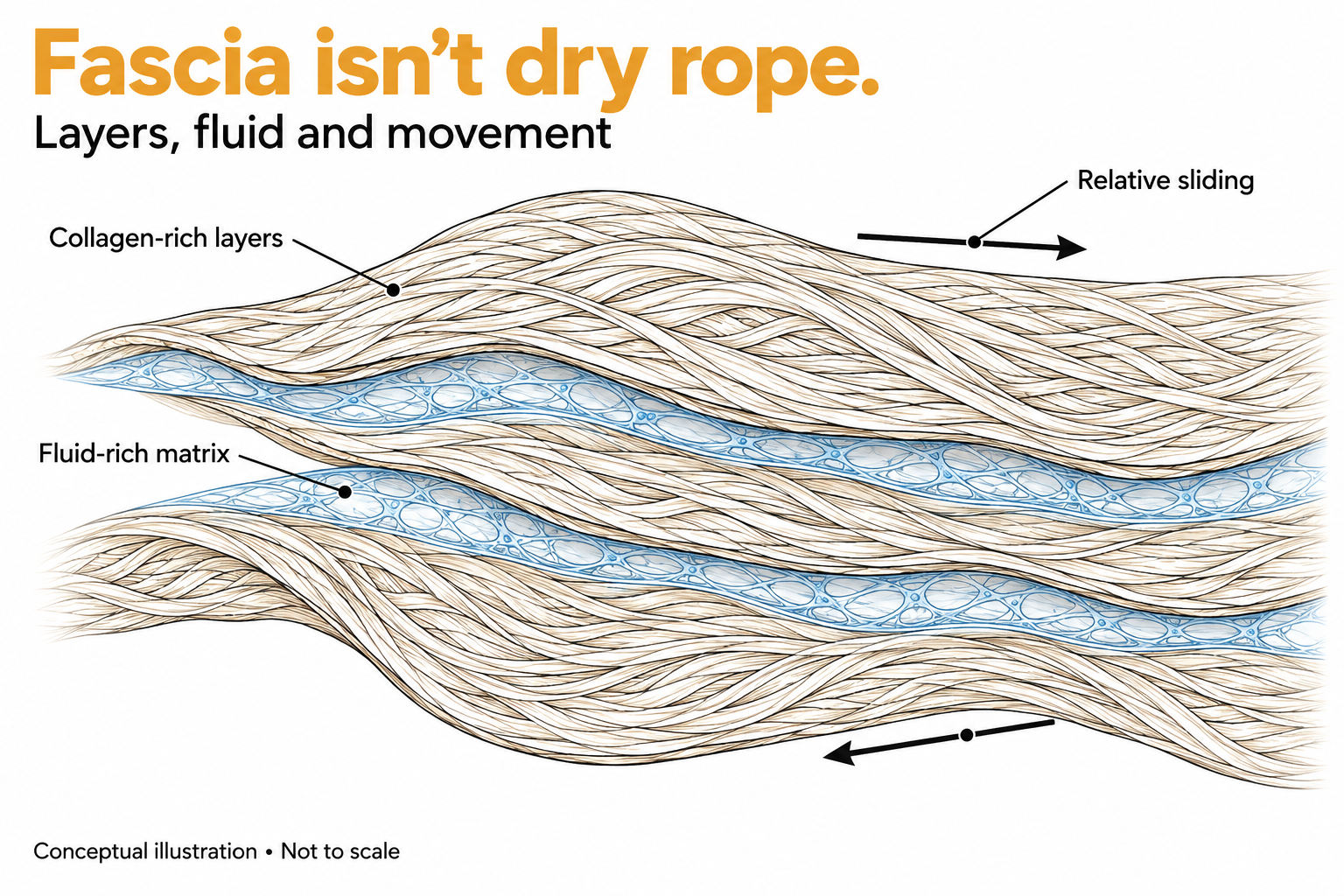
Fascia isn't dry rope. Its fibrous layers are separated by loose connective tissue containing a fluid-rich matrix, including hyaluronan, that helps them slide. Prolonged immobility can alter this matrix and may increase resistance to sliding. Movement and manual pressure may influence its fluid behavior, but how much this explains the improvement someone notices after a session is still being investigated.
3. Adaptation over time
Connective tissue, including fascia and tendon, is living tissue. Its cells respond to the loads they experience (how often, how much, in which directions), and the extracellular matrix adapts to mechanical loading over time. Fascia adapts to its predominant loading pattern, as David Lesondak puts it in The Fascia Connection.
It is also slow. In tendon, collagen production rises after loading, peaks around a day later and stays elevated for about three days. Changes in the tissue's overall structure take much longer than in muscle. Most of this research is on tendon and the connective tissue inside muscle, not fascia specifically, and it isn't a universal timetable. But the direction is the same: repeated input, over time.
One session can begin a response. Substantial remodeling requires repeated input over time.
Release is done to you. Adaptation is built.
The word matters because it shapes what you expect. "Release" is something done to you, once, lying down. If that's the model, the logical next step when things tighten up again is to go and get released again.
Adaptation works the other way. The anatomist John Sharkey makes the clinical version of this point in Understanding Fascia, Tensegrity, and Myofascial Trigger Points: when fascia thickens or shifts, it's doing what it evolved to do. "Try seeing it as a functional adaptation" (p. 137). A change in tissue doesn't automatically mean damage; it may reflect an adaptation to repeated demands.
And if tissue adapts to how it has been used, it can respond to something new. Structural adaptation develops over time, by repeating the right input often enough for the tissue to respond. The quicker changes, in the nervous system and in glide, may open a window. Adaptation is what happens when you keep using that window.
That is the whole logic of a practice versus a single session. It's why the clinical work I do always hands something back to the person to continue on their own. It's also one reason I use slow, loaded, spiraling movement in my qigong teaching: it offers a repeatable way to explore loading and movement, week after week.
If you're in Santa Barbara
Breath, Body, Spine is a six-week qigong series on Saturday mornings at Stevens Park. The first series, starting October 3, is full. The next one will be $185 for six Saturdays, limited to ten people. Join the list for the next series.
— Isaac
Research
- Chaudhry H, Schleip R, Ji Z, Bukiet B, Maney M, Findley T. Three-dimensional mathematical model for deformation of human fasciae in manual therapy. Journal of the American Osteopathic Association. 2008;108(8):379–390. doi:10.7556/jaoa.2008.108.8.379
- Behm DG, Wilke J. Do self-myofascial release devices release myofascia? Rolling mechanisms: a narrative review. Sports Medicine. 2019;49(8):1173–1181. doi:10.1007/s40279-019-01149-y
- Suárez-Rodríguez V, et al. Fascial innervation: a systematic review of the literature. International Journal of Molecular Sciences. 2022;23(10):5674. doi:10.3390/ijms23105674
- Tesarz J, Hoheisel U, Wiedenhöfer B, Mense S. Sensory innervation of the thoracolumbar fascia in rats and humans. Neuroscience. 2011;194:302–308. doi:10.1016/j.neuroscience.2011.07.066
- Schleip R. Fascial plasticity—a new neurobiological explanation: Part 1. Journal of Bodywork and Movement Therapies. 2003;7(1):11–19. doi:10.1016/S1360-8592(02)00067-0
- Schleip R. Fascial plasticity—a new neurobiological explanation: Part 2. Journal of Bodywork and Movement Therapies. 2003;7(2):104–116. doi:10.1016/S1360-8592(02)00076-1
- Keter DL, et al. The mechanisms of manual therapy: a living review of systematic, narrative, and scoping reviews. PLOS One. 2025;20(3):e0319586. doi:10.1371/journal.pone.0319586
- Stecco C, et al. Hyaluronan within fascia in the etiology of myofascial pain. Surgical and Radiologic Anatomy. 2011;33(10):891–896. doi:10.1007/s00276-011-0876-9
- Cowman MK, Schmidt TA, Raghavan P, Stecco A. Viscoelastic properties of hyaluronan in physiological conditions. F1000Research. 2015;4:622. doi:10.12688/f1000research.6885.1
- Kjær M. Role of extracellular matrix in adaptation of tendon and skeletal muscle to mechanical loading. Physiological Reviews. 2004;84(2):649–698. doi:10.1152/physrev.00031.2003
- Magnusson SP, Langberg H, Kjær M. The pathogenesis of tendinopathy: balancing the response to loading. Nature Reviews Rheumatology. 2010;6(5):262–268. doi:10.1038/nrrheum.2010.43
- Kjær M, et al. From mechanical loading to collagen synthesis, structural changes and function in human tendon. Scandinavian Journal of Medicine & Science in Sports. 2009;19(4):500–510. doi:10.1111/j.1600-0838.2009.00986.x
- Lesondak D. The Fascia Connection: Discover the Key to Flexibility, Vitality, and Pain-Free Living. Balance; 2026.
- Sharkey J. Understanding Fascia, Tensegrity, and Myofascial Trigger Points: A Roadmap for Fascia-Focused Therapists. Lotus Books / Human Kinetics; 2026.
About the author
Isaac Osborne is a Certified Advanced Rolfer® and movement educator with nearly thirty years of clinical practice, a Certified White Tiger Qigong Instructor, and the author of the forthcoming book Body of Water.
Get new posts by email
One short email when a new post goes up: thoughts on fascia, breath, qigong, movement, and the space between.
No spam. Unsubscribe anytime.