Why "Feel" Is Harder Than "Think"
Oct 08, 2026When I ask a client to think about something (their posture, a habit, their week), they open up. They lean in. They engage. When I ask them to feel something (the weight of their pelvis, how their right ribs move differently than their left, the temperature in their hands), something often tightens. There's hesitation, sometimes resistance, and often a trace of embarrassment.
I'm not talking about feeling emotions. I'm talking about conscious awareness of bodily sensations: attending to signals from inside the body, alongside our sense of position and movement. Researchers use the word interoception for the broader process through which the nervous system senses and responds to the body's internal state.
That hesitation is common enough to overlook. Once you start looking for it, you notice it in friends, in family, in yourself.
Two qualities of attention
In my teaching, I use yin and yang to describe two qualities of attention. Deliberate thinking often feels active and directed, which is yang. You think about something; you act on it with your attention. Bodily sensing can invite a more receptive quality, which is yin. You don't go out and get a sensation. You let it arrive.
My sense is that modern American culture leans heavily toward yang. We reward production, action, output, decision and control. The receptive qualities (stillness, letting be) can get read as passivity or laziness. So when I ask someone to feel, I may be asking them to drop into a mode they've learned to undervalue.
Feeling can be trained
Many clients have had much more explicit instruction in analyzing problems than in attending to bodily sensations. School, work and screens all train thinking. Far fewer places teach anyone to notice the body.
When I ask someone to notice the right side of their ribcage, I'm asking for a way of paying conscious attention that may be unfamiliar. Part of the hesitation may be discomfort with that receptive mode. Part of it is the ordinary discomfort of being asked to do something you don't know how to do, and feel you should.
The encouraging part is that this kind of attention can be trained. In a study of 148 people, three months of daily body-scan and breath practice improved several self-reported aspects of body awareness, especially how participants used bodily signals to regulate themselves. People with lower initial scores showed larger changes, although improvement wasn't uniform across the measures.
A longer study from the same project, whose program included several contemplative practices, found modest improvements on a heartbeat-tracking task after six and nine months. That task is an imperfect measure of sensing accuracy, since estimation and beliefs also play a part. Some changes may take sustained practice, but that isn't a timetable for everyone.
Feeling can require safety
Feeling can require a sense of safety. For some people, turning attention inward is unfamiliar or uncomfortable. For others, bodily sensations already feel unusually vivid or threatening; more attention to the body isn't automatically better, especially when that attention is focused on threat.
Telling someone who is braced to "just feel" can land the way "just relax" lands on someone who is panicking. It isn't that they don't want to. The invitation needs to be gradual, with room to pause or redirect attention. Therapeutic approaches that teach body awareness build it in stages for this reason.
Identifying with thought
There's one more layer. Many of us learn to identify more readily with our thoughts than with our bodily experience. Asking someone to attend to sensation can therefore feel like a departure from a familiar way of knowing themselves. That's a bigger ask than it sounds.
Why this matters
It would be easy to read all of this as a curiosity about culture and philosophy. It isn't. Interoception is a biological function. It is how the body registers its own state (effort, fatigue, tension, the need to speed up or slow down) and adjusts.
Research links interoceptive awareness with emotion regulation: how well people manage their responses to stress and emotion. When early signals go unnoticed, the default is often to push through and override. What I see clinically is people who miss the small, early information: the slight tension, the first sign of fatigue, the shift that, if they registered it sooner, might let them adjust earlier.
The answer isn't to flip the polarity. A culture that valued yin over yang would have its own problems: stagnation, passivity, an inability to act when action is needed. Both qualities matter. Both need development. The problem, as I see it, isn't that we value yang. It's that yin gets neglected.
A practice in feeling
Many people approach posture as a problem to solve from the outside. Stand up straight. Pull your shoulders back. Tuck your pelvis. Lift your chest. That's a thinking practice: you impose a shape on the body from above, correcting and controlling until it looks right.
In my experience, posture has as much to do with coordination: how the body has learned to organize itself in space, what it habitually grips and what it lets go of. Some of what we call good posture is what's left when unnecessary effort drops away.
Some clients respond to posture instructions by holding themselves rigidly. They pull the shoulders back and hold them, brace the core, tuck the pelvis and lock it there. That shape takes constant effort, so it tends to fade as soon as attention wanders. In those cases, I find it useful to shift attention toward support, breathing, and unnecessary effort.
The Taoist practices I teach take that approach. They emphasize feeling over doing: noticing how weight moves through the feet with each breath, where the body is holding effort it doesn't need, how the trunk widens on the inhale and settles on the exhale. That is interoception in practice: noticing information about your own alignment and organization in real time, and responding to it instead of overriding it.
The simplest version is Zhàn Zhuāng (pronounced "jahn-jwahng"), standing post. You stand, feet about shoulder-width apart, knees soft, arms held loosely in front of you as if around a tree. Breathe naturally and comfortably, without trying to make the breath deeper or slower. Notice what happens in the body as you stand. Three to five minutes is a good place to start. If focusing inward feels overwhelming, you can shorten the practice, sit down, or bring your attention back to the room.
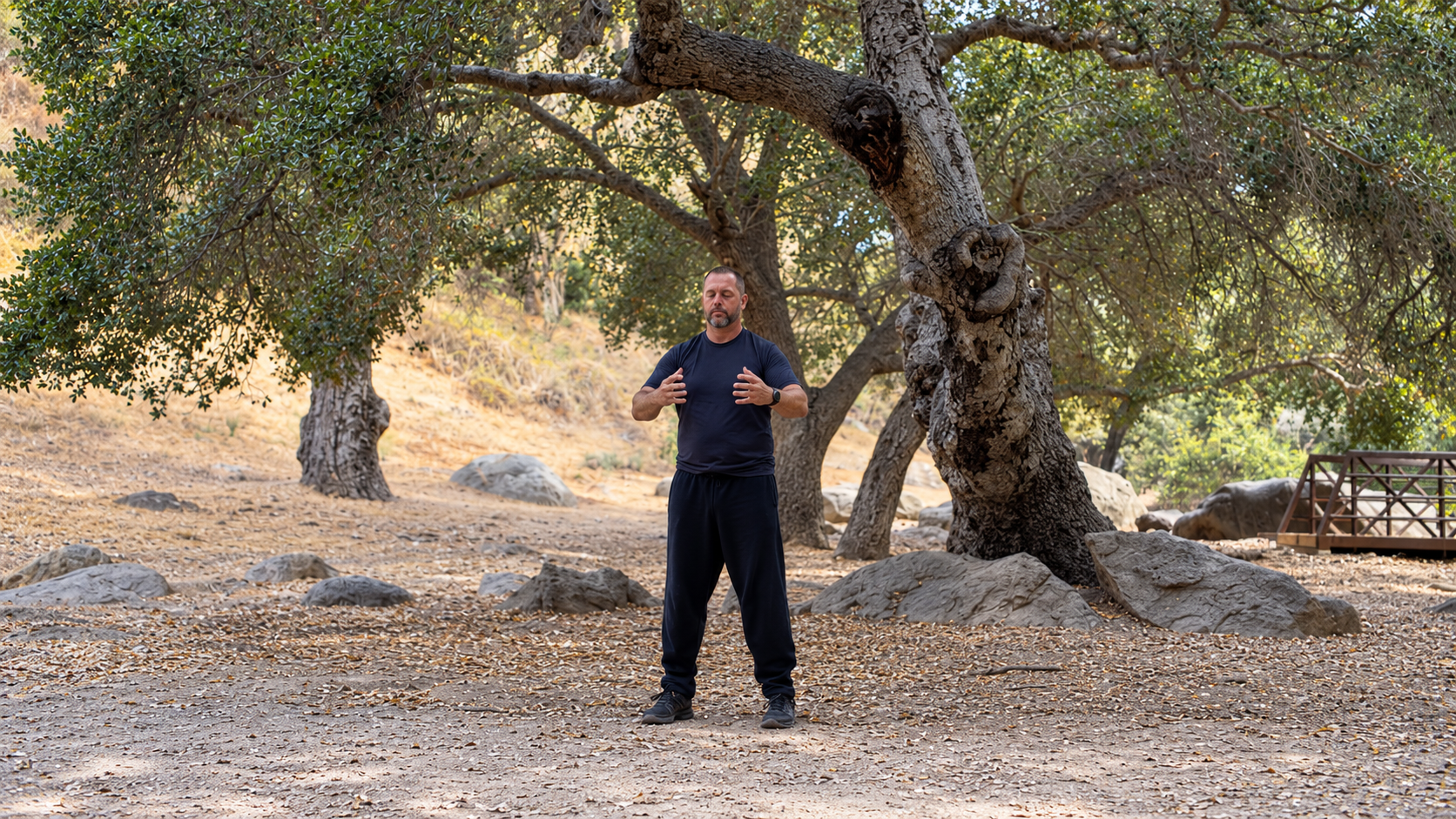
That's the whole thing. You're not pushing the body into position, measuring angles or controlling the breath from above. You're letting the structure organize itself (the feet taking the weight, the spine lengthening, the breath finding its own depth) and noticing. The noticing is where the feeling lives. Often the body needs less instruction than we think. It needs permission to stop gripping long enough to find its way.
The work
For years, clients who have worked with me in Structural Integration (Rolfing®) have asked the same question: how do I keep this? The sense of alignment and ease they find in a session, how do they get back to it on their own?
Corrective exercises can be useful. They restore range of motion and retrain movement patterns. I also use standing practice to give clients time to explore bodily sensations without trying to achieve a particular shape, which is a large part of why I've brought qigong into my own practice and my work with clients.
When I ask someone to feel and they freeze (the moment of uncertainty, the slight embarrassment, the sense that they should know how to do this and don't), I take that hesitation as a cue to slow down and make the invitation more concrete. Standing practice meets that hesitation with structure. You don't have to know what you're looking for. You stand, soften wherever you notice effort, and let the body show you. For me, in my own practice, that shows up as a sense of being in my body rather than managing it from somewhere above it. What it shows up as for you is yours to find out.
I think of this as remedial education in yin. The resistance you notice, in others or in yourself, is what you'd expect when someone is asked to pay attention in an unfamiliar way. The work isn't to value feeling over thinking. It's to stand, soften and notice.
If you're in Santa Barbara, I teach qigong classes here.
— Isaac
Rolfing® and Rolfer® are registered service marks of the Dr. Ida Rolf Institute®. Isaac Osborne is a Certified Advanced Rolfer®.
Research
- Chen WG, et al. The emerging science of interoception: sensing, integrating, interpreting, and regulating signals within the self. Trends in Neurosciences. 2021;44(1):3–16. doi:10.1016/j.tins.2020.10.007
- Bornemann B, Herbert BM, Mehling WE, Singer T. Differential changes in self-reported aspects of interoceptive awareness through 3 months of contemplative training. Frontiers in Psychology. 2015;5:1504. doi:10.3389/fpsyg.2014.01504
- Bornemann B, Singer T. Taking time to feel our body: steady increases in heartbeat perception accuracy and decreases in alexithymia over 9 months of contemplative mental training. Psychophysiology. 2017;54(3):469–482. doi:10.1111/psyp.12790
- Desmedt O, Luminet O, Corneille O. The heartbeat counting task largely involves non-interoceptive processes: evidence from both the original and an adapted counting task. Biological Psychology. 2018;138:185–188. doi:10.1016/j.biopsycho.2018.09.004
- Price CJ, Hooven C. Interoceptive awareness skills for emotion regulation: theory and approach of Mindful Awareness in Body-Oriented Therapy (MABT). Frontiers in Psychology. 2018;9:798. doi:10.3389/fpsyg.2018.00798
- Farb N, et al. Interoception, contemplative practice, and health. Frontiers in Psychology. 2015;6:763. doi:10.3389/fpsyg.2015.00763
About the author
Isaac Osborne is a Certified Advanced Rolfer® and movement educator with nearly thirty years of clinical practice, a Certified White Tiger Qigong Instructor, and the author of the forthcoming book Body of Water.
Get new posts by email
One short email when a new post goes up: thoughts on fascia, breath, qigong, movement, and the space between.
No spam. Unsubscribe anytime.