The Water You Breathe
Oct 29, 2026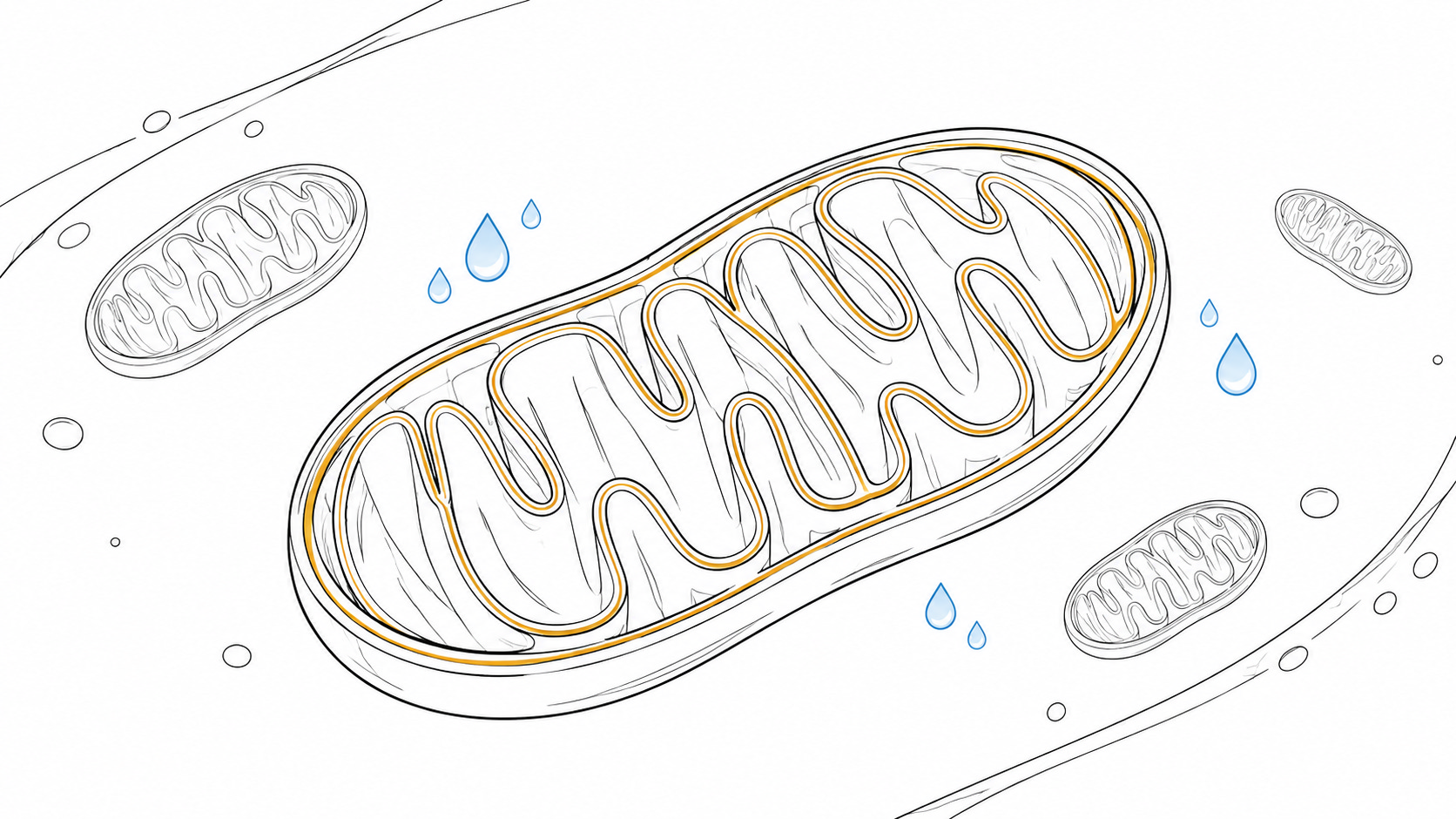
Recently, a client asked me a question I couldn't answer: how is carbon dioxide actually formed in the body? Even after almost thirty years working with breath, I realized I hadn't really explored this. So I looked into it, and the answer surprised me.
I used to imagine that the oxygen I breathe in simply comes back out as carbon dioxide, just in a different form. In goes O2, out comes CO2. It sounds neat, but that's not actually what happens.
A lot of the oxygen you inhale is just breathed back out. The oxygen that your mitochondria use for energy has a special role. When that process finishes, it turns into water.
Where the oxygen goes
Your cells turn food into energy through a series of reactions, most of which happen inside the mitochondria. During this process, electrons are taken from the fuel and passed along a chain of proteins, similar to a bucket brigade. The energy released moves protons across a membrane, and as they return, they help make ATP, which is the cell's main energy source.
At the end of this chain, the used electrons need a place to go. That's where oxygen comes in. Oxygen acts as the final electron acceptor—it takes the electrons, joins with hydrogen, and turns into water. If there's no oxygen at the end, the whole process stops. That's the basic reason why we need to keep breathing.
This water is called metabolic water. It mixes with the rest of your body's fluids, just like the water you drink. For someone who isn't very active, it's about 250 to 350 milliliters a day—roughly a cup to a cup and a half. If you're more active, it can go up to 500 to 600 milliliters. These numbers are estimates and depend on how much energy you use and what kind of fuel your body burns.
This isn't just theory from textbooks. In 1949, researchers gave animals oxygen marked with a heavy isotope and followed where it ended up. They found it in the body's water.
Where the carbon dioxide comes from
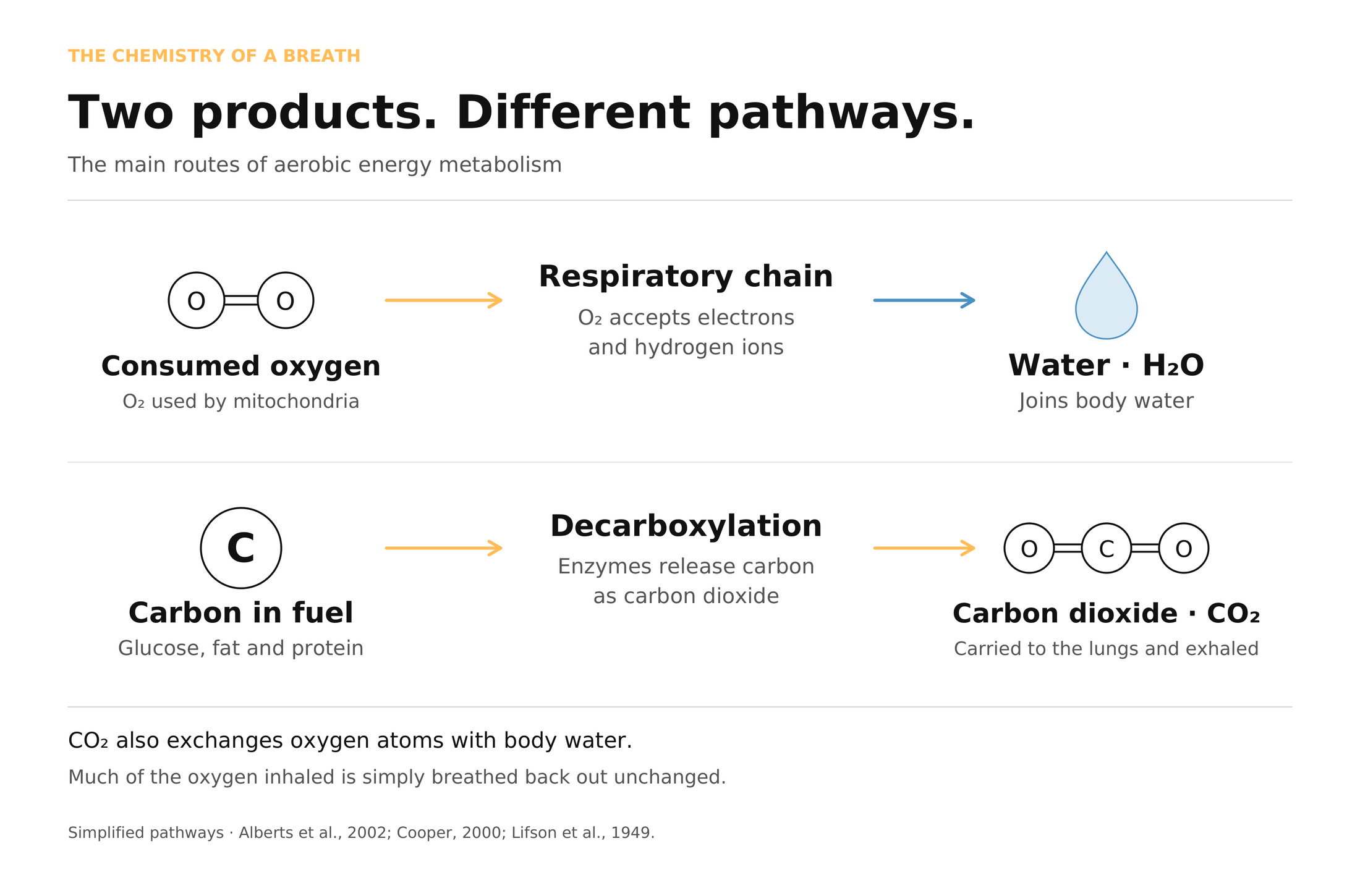
If the oxygen turns into water, then where does the CO2 come from? It comes from your food. As your body breaks down glucose, fat, and protein, enzymes remove carbon in reactions called decarboxylation. Most of this happens when pyruvate turns into acetyl-CoA and during the citric acid cycle, before the electrons reach oxygen. The carbon you breathe out was recently part of your food or your body's stored energy.
The oxygen atoms in CO2 come from the fuel molecules and from water, not straight from the air you just breathed in. The 1949 study showed that the oxygen in exhaled CO2 swaps with the oxygen in the body's water, since carbon dioxide and water are always exchanging oxygen atoms. This means that oxygen atoms turned into water during respiration can later leave the body as part of carbon dioxide.
This leads to an interesting result. In 2014, Ruben Meerman and Andrew Brown figured out where fat goes when we lose it. They found that about 84 percent of fat's mass leaves the body as carbon dioxide through the lungs, and the other 16 percent leaves as water. Breaking down 10 kilograms of fat uses 29 kilograms of oxygen and produces 28 kilograms of CO2 and 11 kilograms of water.
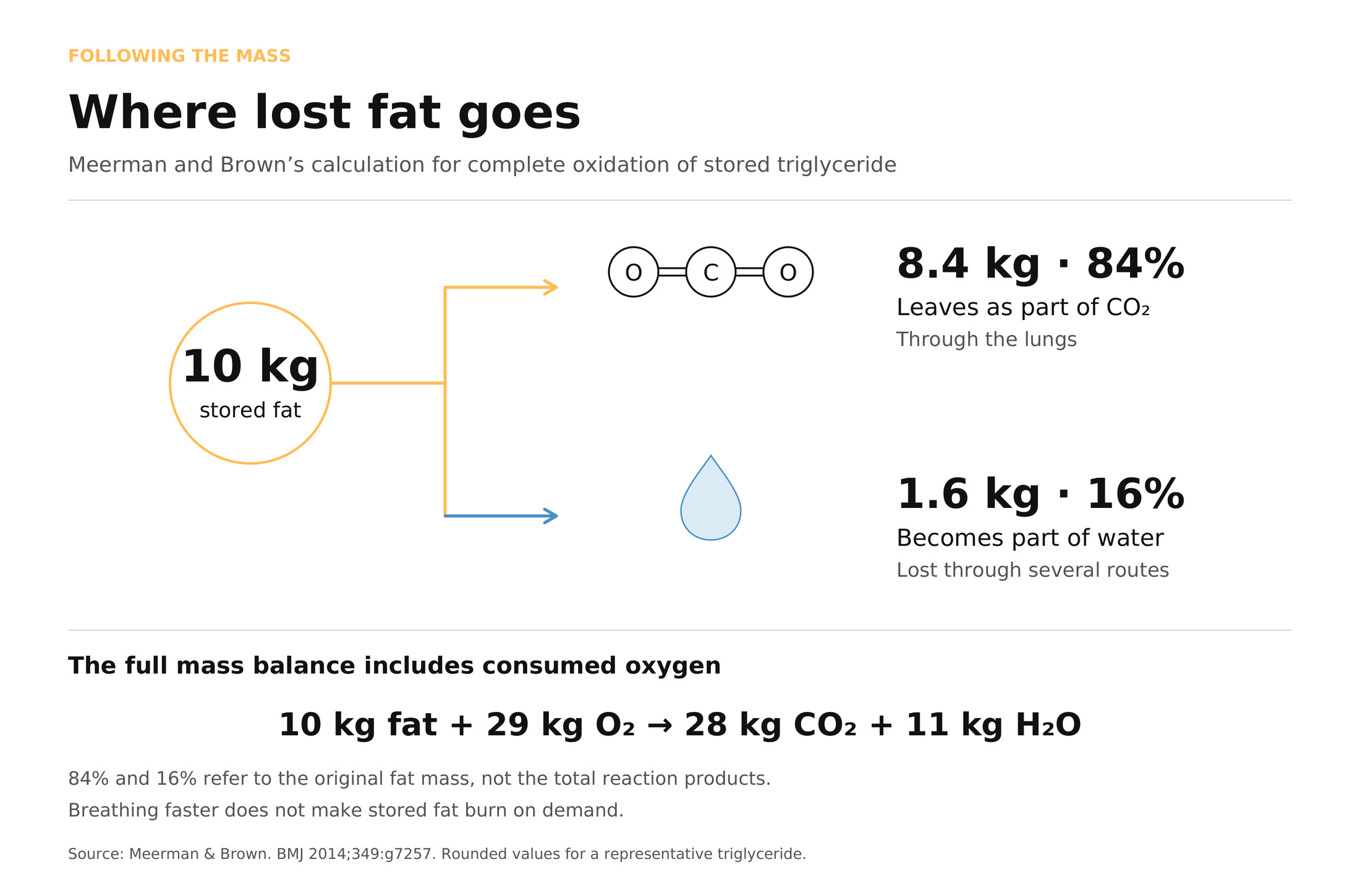
This explains the chemistry, but it's not a weight-loss trick. Breathing faster won't make your body burn fat on command; the rate depends on how much fuel you're actually using. Still, when you lose fat, most of it leaves your body through your breath, one exhale at a time.
A transfer of material
When you put these two parts together, breathing looks different. It's not just swapping one gas for another. Breathing brings in oxygen for metabolism and removes carbon as CO2. This process also creates water, and each breath loses some water as vapor. With every breath, material moves through your body.
A quick note, since it's easy to misinterpret this. This is about the chemistry of the whole body. Metabolic water mixes with all your body water, and the water you lose by breathing is about the same. Breathing doesn't hydrate specific tissues, and taking deeper breaths doesn't create more metabolic water. The amount depends on how much fuel you're burning, not your breathing style.
Breath as structure
This connects to my own work. For years, I've seen breath as more than just gas exchange. In both the clinic and in qigong, I focus on breath as a mechanical process: the diaphragm moves, pressures shift in the chest and abdomen, and the respiratory muscles help support the trunk. In a small experiment, increasing abdominal pressure by stimulating the diaphragm made the lower spine stiffer. The study only involved three people and a specific lab technique, so it doesn't show what happens with every breath, but it points in the same direction.
The chemistry adds another layer to this view, and I want to be clear that what follows is my own interpretation, not settled science. I picture the body as a fluid, pressurized system. This is just a model, not a literal description—the trunk also contains organs, tissue, and gas. In this model, breath isn't just a force on the container. It's also part of how the contents are created and removed.
This idea—the body as a fluid, pressurized system and what that means for movement and breathing—is at the heart of the book I'm finishing, Body of Water.
Some of the most valuable things I've learned have come from clients asking questions I couldn't answer. This was one of those moments.
If you want to know when the book is ready, you can join the Body of Water launch list.
— Isaac
Research
- Lifson N, Gordon GB, Visscher MB, Nier AO. The fate of utilized molecular oxygen and the source of the oxygen of respiratory carbon dioxide, studied with the aid of heavy oxygen. Journal of Biological Chemistry. 1949;180(2):803–811. doi:10.1016/S0021-9258(18)56700-4
- Institute of Medicine. Dietary Reference Intakes for Water, Potassium, Sodium, Chloride, and Sulfate. Chapter 4, Water. Washington, DC: National Academies Press; 2005. doi:10.17226/10925
- Meerman R, Brown AJ. When somebody loses weight, where does the fat go? BMJ. 2014;349:g7257. doi:10.1136/bmj.g7257
- Alberts B, et al. How cells obtain energy from food. In: Molecular Biology of the Cell. 4th ed. New York: Garland Science; 2002. NCBI Bookshelf NBK26882
- Cooper GM. The mechanism of oxidative phosphorylation. In: The Cell: A Molecular Approach. 2nd ed. Sunderland, MA: Sinauer Associates; 2000. NCBI Bookshelf NBK9885
- Hodges PW, Eriksson AEM, Shirley D, Gandevia SC. Intra-abdominal pressure increases stiffness of the lumbar spine. Journal of Biomechanics. 2005;38(9):1873–1880. doi:10.1016/j.jbiomech.2004.08.016
About the author
Isaac Osborne is a Certified Advanced Rolfer® and movement educator with nearly thirty years of clinical practice, a Certified White Tiger Qigong Instructor, and the author of the forthcoming book Body of Water.
Get new posts by email
One short email when a new post goes up: thoughts on fascia, breath, qigong, movement, and the space between.
No spam. Unsubscribe anytime.